Energy – Episode 1
Click here for downloadable PDF version.
Previously…
In the prologue to this series, we established a basic fact about science: science builds models of reality, explaining how the world works around us. So what scientists do is observe and then distill their observations into a model. Then they test and refine. The end result is a collection of rules that enable us to predict what will happen in situations described by those rules. The reliability of such rules is something that engineers gladly take advantage of when designing systems that leverage the very phenomena that scientists' models describe. Now, over time, some rules emerge as "fundamental laws" of science. They turn out to be valid for all the models ever built so far. We mentioned two such laws, one of them is about the conservation of energy (something this paper discusses in detail), and the other one is about the relationship between an object’s movement and the force you apply to it. Let’s briefly recall what this latter one is about.
Well, it’s more than one law actually, and we have Newton to thank for all of them:
-
We pushed trolleys in the supermarket, trying to accelerate them, or change the direction of their movement. We have found it is much easier to make an empty trolley react than a fully loaded one. And so we have come to the conclusion that the force affecting an object is equal to the mass of that object multiplied by the acceleration of the object.
-
We also recalled the proverbial story about the apple falling from a tree and hitting Newton’s head, making him wonder about the force dragging the apple to the ground. Yes, this is gravity, the force that Earth exerts on any massive object.
-
Then we combined our knowledge of trolleys and apples and discussed the forces present when two objects interact with each other, like us pushing the trolley and the Earth attracting the apple to the ground. Actually, both objects involved in an interaction will exert some force on the other. In the case of gravity, this force is defined by the mass of the objects, their distance, and something called the "universal gravitational constant".
Introduction to energy
Let’s be clear from the start. Energy is the most brilliant concept ever worked out by scientists. Not the most complicated one, but certainly the most fruitful and the most universal. As said before, science (physics and chemistry in particular) is about finding models that work, i.e., repeatedly predict nature’s behaviour. Bear in mind though that these are models that always work under certain conditions only. Energy, however, is present, central even, in absolutely every model in physics, chemistry, and all their branches. I’ll come back to this later.
What is so brilliant about the concept of energy? Let’s look at the common meaning of the term: a reasonable definition of "energy" is to say that energy is the capacity and will to act. That is not far from the meaning of the ancient Greek term "energeia" = activity, operation. And actually, not far from the scientific definition itself. It’s a property attached to an object, quantifiable, which reflects the "effort" that has been put into that object. The energy that has been put into it – in a number of possible ways.
An obvious way to put energy into an object is to apply a force that accelerates it. It then acquires energy in the form of speed, and intuition tells us that the higher the speed and the more massive the object, the greater the energy. It’s called kinetic energy.
You can also heat up the object. Its increased energy is then materialised by its higher temperature – which, interestingly, is due to its molecules [1] moving faster and faster in a random way, so in fact it’s some kind of kinetic energy as well.
You can also take your object up a mountain. Then it acquires "potential energy" – the higher it is, the higher its potential energy. If you drop it off a cliff, it will be accelerated by gravity – gaining kinetic energy but losing potential energy. It transforms its potential energy into kinetic energy.
And this transformation is exactly the concept behind the crazy idea that scientists came up with in the 19th century: the total energy in the universe is constant. Energy only transforms, i.e., takes different forms, all quantifiable with the same measuring units, and the overall quantity is always the same. If you take an isolated system, i.e., a group of objects that do not interact with the rest of the world, the energy within this system remains constant as well (the trick is to properly identify when a system can be considered isolated, as it can have hidden interactions with outside objects). Again, energy can change in form, but it remains constant in total value. I find this quite satisfactory intuitively. Modern physics has found profound mathematical interpretations of energy conservation, but the intuitive interpretation is fine by me: there is no free lunch, and nothing disappears either. Energy just transforms. Another way of putting it is that energy can be stored in many forms – but never lost or created. And arguably most (if not all) of physics and chemistry is about how energy transforms.
In the following, we will go through some of the many forms energy can be stored in, and also look at practical situations where it changes form. Some very well-known phenomena can be nicely explained by just asking ourselves: where is the energy going? where is it coming from? how does it transform? Some odd or unexpected phenomena will also present themselves on the way.
How energy is quantified
(If you really don’t like numbers, you can skip this section. The key takeaway to remember is that energy, whatever its form, is measured in joules (J), or smaller units (amounting to a minute fraction of a joule) when calculating with smaller units is more convenient. Also note that power refers to energy delivered per second, and is measured in watts = joules per second.)
Before starting our discussion of energy in earnest, a few words about how energy is quantified. You will come across a couple of formulae in this paper, no escaping that. I will not seek to prove these formulae; just remember that they correspond to a model. There is one thing to explain briefly though. If we decided to measure energy with different units, these formulae could be multiplied by, say, 2 or 4 and still be valid. But once a convention has been agreed as to the unit of measurement, the formulae need to be accurate, and their coefficients set so that energy remains constant when it takes different forms.
The way energy is modelled is such that, whatever its form, you can always measure it in units corresponding to a mass multiplied by the square of speed (kg x m/s x m/s) [m/s = metres/second]. The corresponding official unit is called the joule (J), and it’s a handy unit to measure "normal" (i.e., human-size) energies. When we look at very small particles (and we will!), then J is not a convenient unit: all values would be like 0.00000000000000001J. Therefore, we will be using a much smaller unit called electron-volt (eV) – more about this in the next paper, but for now, all you need to know is that 1 joule = 6 billion billon electron-volts!
Closely related to energy is power so let’s talk a little bit about how power is quantified. Power, in physics, is an energy variation per second. For example, the power of a car engine is the amount of energy per second it can deliver. Power is measured in watts (W): 1W = 1J/s. You could equally say that 1J = 1W x s (joule = watt multiplied by seconds); this reflects the fact that energy is obtained by multiplying power (watts) by the duration of power delivery (seconds). In practice, we obviously use J instead of W x s, but in electricity we do use the watt x hour (Wh, pronounced "watt-hour") as a unit. 1Wh is the energy delivered by a 1-watt source in one hour, i.e., in 3600 seconds: 1Wh = 3600J. More about electricity later!
Now it’s time to start with…
Kinetic energy – or "energy and force"
Kinetic energy is the energy of an object of certain mass travelling at a particular speed. The way I "sense" kinetic energy is: how much effort it takes to bring the object to that speed, or how hard it is to stop it… Therefore, we can expect kinetic energy to grow with both the mass and the speed of the object. In fact, it grows more with speed: it is proportional to the mass (noted as m) of the object, and to the square value of its speed (noted as v2, because you may remember that the trendy name for speed in physics is velocity).
The exact formula is:
(kinetic) Energy = \$1/2mv^2\$
Why "1/2"? Well… at least two answers to this – pick yours, they are both valid!
-
Answer 1: Because of the way the joule unit has been calibrated.
-
Answer 2: To make the value consistent with the other forms of energy that kinetic energy can transform into.
Now when we talk about "the effort it takes to bring the object to that speed", of course we want to relate this to the force we need to apply to this object in order to accelerate it to that speed: we guess that Newton’s famous law, force = mass x acceleration (or f=m\$\gamma\$), is not far. Not far at all… it just takes a different interpretation here, showing how a force injects kinetic energy into an object if it pushes along its movement, working "positively" to increase speed, or draws kinetic energy from the object if it resists the movement of the object, working "negatively" to decrease speed. I promise the energy-based model gives the same results as Newton’s law… I also promise I won’t take you through the maths that proves it, but we should remember this concept of positive or negative "work" of a force: the work of a force is the kinetic energy (positive or negative) it injects into an object. Let’s detail this a bit. Suppose an object is initially at rest (not moving) and then a total force f is applied to it, with f assumed to be constant for the sake of simplicity. As f=m\$\gamma\$ sets the object into motion, the object starts gathering kinetic energy. A bit of maths will tell you that, after covering distance d, the object will have gained a kinetic energy equal to f x d:
Ek = work of f = fd
If the object is initially moving, then we have two cases:
-
f may "push along" the motion of the object, increasing its velocity. In that case, after covering distance d, the object’s kinetic energy will have increased by f x d. The sign ∆ symbolising a variation, we note: ∆Ek = work of f = fd.
-
Inversely, f may resist the object's movement and slow it down; in which case the object’s kinetic energy will decrease [2] by f x d after the object has covered distance d. If we count f as negative when it resists motion, the formula ∆Ek = work of f = fd remains valid, the negative result accounting for the negative variation of Ek (or, equivalently, the negative work of f).
If we look at power P, i.e., the object’s energy variation per second, the above formula naturally becomes:
P = fv, v being the object’s velocity.
Here you may ask: but what if f is not parallel to direction of the initial motion? Well, from the prologue we know that we can break down f into a component that is perpendicular to an objects’s motion and another component that is parallel to it. The perpendicular component does not modify velocity’s amplitude, which means that it does not impact kinetic energy. Therefore the above simply applies to the parallel component of f. Vectorial calculation would allow us to summarise all of this is as a simple, more general formula, but that would require a bit of mathematical preparation that we may not want here.
Next question? Ah yes of course, a very good question indeed: yes, this kinetic energy formula is only valid under certain conditions. It works fine for "reasonable" speeds. However, at a very high speed, i.e., when velocity is no longer negligible against the speed of light, things get a bit more complicated… More on this later – hint: in reality, the kinetic energy of an object reaching the speed of light would be infinite, which shows that our formula obviously doesn’t work…
Thermal energy
As mentioned earlier, the temperature of an object reflects the movement of the object’s molecules moving faster and faster in a random way, in all directions (no movement at macroscopic level). The thermal energy of our object is the kinetic energy of its randomly moving molecules. It depends on:
-
the temperature of the object
-
its number of molecules, hence its mass
-
a physical property of the object’s material called "specific heat", noted cp
Basically, if you want to heat up an object, you need to provide an amount of energy equal to temperature_increase x mass x specific heat – or, reusing ∆ to indicate variation: E = mcp∆T. Makes sense, I think. If the provided energy is supplied by fire, it will actually come from the chemical energy stored in the wood (see below about chemical energy). Then, if the object cools down to its initial temperature, it will shed the exact same energy – this energy typically heating up its environment. Note that water has a pretty high specific heat [3] – we will come back to this later when talking about "state energy".
I said that the molecules' thermal movement does not create any movement at macroscopic level. However, in some cases, thermal energy can turn into visible "macroscopic" kinetic energy. If gas is confined in a finite volume (say air in a tyre’s inner tube), its randomly moving molecules are stopped by the inside of the tube, bouncing on it. This results in a force applying to all the inside surface of the tube, modelled by the concept of pressure – a force per unit of surface. Molecules "pushing" the inside of the tube, if you will.
If you release the valve of the tyre, then air molecules will find space to move, but only in one direction – through the valve. Air will move in that direction, acquiring "macroscopic" kinetic energy. Of course, with the total energy remaining constant, this results in a loss of "microscopic" kinetic energy – i.e. of thermal energy. The released air cools down. Put your finger by the valve, it’s really cold there!
Temperature and pressure
If we take this a bit further… what if you heat up the confined gas? You can guess what happens, right? Molecules start moving faster, bouncing harder on whatever confines them. Pressure increases. At one point, this may strain the confining object. A dramatic example of this is volcanic eruptions, when the enormous pressure resulting from high temperatures tears the top or the side of the volcano. This results in a massive transformation of thermal energy into "macro" kinetic energy, commonly called an explosion.
A few more words about pressure. Pressure increases with a rise in temperature, i.e., higher molecule speed, or molecules pushing harder. But it also increases with a rise in molecule density, i.e., more molecules pushing per unit of surface. If you pump air into a tube, pressure inside the tube increases and stretches the tube – the outer surface becomes harder. In fact, a good (and widely used) model consists in using the following formula: P = ρRT. You will guess that P stands for pressure and T for temperature. ρ is gas density (number of molecules per litre), and R is a fixed number called "ideal gas constant". In some cases, P suddenly increases with a sharp increase of both ρ and Τ, leading to an explosion. As we go along, we will discuss some useful – and sometimes dreadful – examples.
Here you are entitled to complain – or at least to ask a question. If P = ρRT, then P = 0 when T = 0. But there is still pressure inside my tube, right, even at 0°C? And what about negative temperatures? Negative pressure doesn’t make sense…
Quite right, and thanks for reading so carefully! In physics, we use a slightly different temperature scale. We measure temperature in "Kelvin degrees", or simply "Kelvins" (symbol K). The Kelvin and Celsius scales use the same increment, i.e., 1K = 1°C as a temperature difference. However, the "zero" of Kelvin’s scale, also called "absolute zero", is very different to 0°C. Logically, I think, it corresponds to a state where the object’s molecules are completely still, meaning that their microscopic kinetic energy is zero. And indeed, in that case, the pressure in our tube is zero (and incidentally, the air inside it has turned solid…).
Zero Kelvin corresponds to -273°C. Nice and cool. Actually, it doesn’t get cooler than that: a temperature measured in Kelvins cannot be negative.
Radiated energy or electromagnetic energy
Radiated energy, or electromagnetic energy, is the energy carried by electromagnetic waves. What’s that? It’s a bit of an abstract concept, I admit. But pretty useful. OK, let’s try. The most famous electromagnetic waves are materialised by light, however visible light is but a small subset of a broader range of electromagnetic waves. Let’s elaborate a bit.
Light is modelled by a non-material wave that propagates in the void or through transparent matter such as air. This wave travels fast. I mean, really fast. 300000km/s, referred to as the speed of light, noted as c. At our scale, it goes from one place to another pretty instantly. But not quite. And if you take a very long distance, you start noticing propagation delay. For instance, light coming from the Sun takes about 8 minutes to reach us.
Now, like any well-behaved wave, light has a wavelength – the distance between two crests of a wave, in fact between two peaks of an electric field. What’s that again, you may ask? OK… An electric field is the active space that surrounds electrically charged objects or particles. It exerts a force on other charged objects/particles situated within this active space, attracting or repelling them. It is the same type of field that constitutes electromagnetic waves – only it is radiated by a hot source instead of being created by a charged object [4]. Can I go back to my wavelength now?
Wavelength is commonly noted as \$\lambda\$. The diagram below provides some visual aid to understanding wavelength: the red curve shows the amplitude of the electric field along the propagation line, and the red arrows show the direction of the force it exerts. Note that it comes with a magnetic field applying its force perpendicularly (blue curve) – hence the term “electromagnetic” [5] energy/wave/field. Both curves (hence the wave) propagate along the black “direction” arrow at the speed of light.
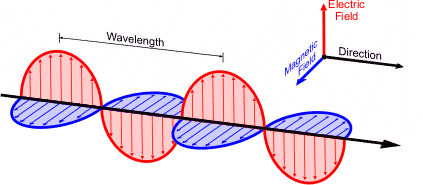
As the wave propagates, the crests travel at speed c – the speed of light. If we stand at a given position as the wave goes by, the field oscillates from being a "crest" to being a "trough" and back – imagine an anchored boat bobbing up and down as sea waves go past. The period of this oscillation is the time between two passing crests, i.e., the time it takes for the wave to travel one wavelength. So it’s easy: the period is equal to the wavelength divided by the speed of light, or \$\lambda\$/c, expressed in seconds. The frequency of the wave is the number of periods per second, noted \$\nu\$. So \$\nu\$ is simply 1 second divided by the period: \$\nu\$ = 1/(\$\lambda\$/c), or more simply \$\nu\$ = c/\$\lambda\$, expressed in Hertz (=units per second, noted as Hz). The shorter the wavelength, the higher the frequency. This "frequency" is the one that appears in the common language too when we speak about radio waves – yes, radio waves are electromagnetic waves like light, but at different (much lower) frequencies. Indeed, it is the frequency attached to radio stations – we can now make a bit more sense of it… Electromagnetic waves’ frequency also happens to be closely related to their capacity to exchange energy with matter, but this will be for our next paper…
Electromagnetic waves' wavelengths (hence frequencies) can take a very wide range of values that lead to very different behaviours. We will see below that completely different phenomena are all electromagnetic waves – just with very different wavelengths. This large span of values will prompt use to use various units of measurement that we will introduce along the way (see also the Reference Annex that closes the Energy Prologue paper). In the case of light, wavelength (or, equivalently, frequency) defines the colour of the light wave. Its longest wavelength (\$\lambda\$ = 700nm [6] is visible as red, its shortest (\$\lambda\$ = 400nm) as violet. In between, a continuum of colours. Now what if an electromagnetic wave is longer than a "red" wave or shorter than a "violet" one? Well, it’s still an electromagnetic wave propagating at 300000km/s. As wavelength increases beyond red, we can no longer see it, but we can still detect it. Just a bit longer than red (\$\lambda\$~700nm to 100µm [7], we get "infrared". Infrared waves interact with matter in a very interesting way: they easily transfer their energy to matter, heating it up. Think infrared heating.
If we increase wavelength further, we reach the range of microwaves (\$\lambda\$~1cm to 1m; a famous example is \$\lambda\$ = 12.5cm, or equivalently f = 2.4GHz [8], for Wi-Fi… and microwave ovens); then radio waves – used to transmit radio and TV (\$\lambda\$~meters to kilometres, e.g. \$\lambda\$~3m or f = 100MHz [9] for FM radio).
Now if we go to shorter wavelengths than visible light: beyond violet, we get ultraviolet rays (10nm, responsible for our tan and sunburns), then X-rays (0.1nm, used for radiography), then gamma rays (1pm [10], typically produced by nuclear reactions and pretty dangerous because their very high energy causes odd reactions when they interact with matter). All of these are electromagnetic waves. They have very different behaviours though, which reflects their incredible wavelength range: from kilometres to picometres, or even less for some cosmic rays. To figure out how short a picometre is: the size of an atom is about 100 picometers. And you can string 10 million atoms in 1mm.
So, are electromagnetic waves important energy-wise? Well, sort of… Put simply, almost all the energy around us ultimately comes from the Sun, carried by electromagnetic waves – mainly infrared to ultraviolet. These are either reflected to space (keeping their energy) or absorbed by air, the ground, water, plants, plankton – or us sunbathing. It just heats up the air, the ground, and the sunbathers. Water, plankton, and plants are interesting because they don’t just heat up, they also transform energy in more elaborate ways – more on this later.
Then, at night, the ground, the air, water, etc., radiate this energy back, mainly as infrared, and consequently cool down: thermal energy re-transforms into radiated energy. Now here come our climate issues: part of the infrared radiated by the ground at night is absorbed by the atmosphere, heating it up instead of leaving the Earth for good. The more carbon dioxide in the atmosphere, the more infrared is absorbed. This doesn’t apply to other wavelengths, so most of the incoming solar energy gets through, while the nightly outgoing infrared is trapped. Human activity increases the amount of carbon dioxide in the atmosphere because of our reliance on processes that use combustion. Combustion – burning petrol, coal, wood, anything that contains carbon – produces carbon dioxide. So the Earth is becoming a "solar energy trap". It stores more and more energy in the form of thermal energy, and consequently the average temperature increases. Snow and ice melt, which viciously accelerates the process: as the amount of white surface on the Earth decreases, so does the proportion of sunlight that is reflected to space. More sunlight is absorbed – with its energy transformed into thermal energy. By now, even our oceans have started warming up significantly, in spite of their huge mass and very high specific heat. Reversing the process will take centuries…
Potential energy
Potential energy is… a "potential for energy" that an object has acquired by reaching a certain state or position. This potential energy can be released by going to another, "lower energy" state or position. The released energy doesn’t disappear of course, it just takes another form – many options here. And sure enough, if you want your object to go back to its initial state or position (which, mind, is not always possible), there will be no free lunch: you’ll have to provide it with the exact same amount of energy it released in the first place.
Potential energy can take sooo many forms. Some examples follow…
Gravitational potential energy
Gravitational potential energy is obtained by gaining altitude (note that it takes an effort, the energy has to come from somewhere!). As mentioned above, if the object is then left alone and motionless in the air, it will be accelerated by gravity. Going down, it will lose potential energy but will gather the exact equivalent in the form of kinetic energy. With gravity, potential energy is simply mass x g x altitude, noted Ep = mgh (remember g is the gravitational acceleration). Super handy if you want to calculate the speed (velocity v) gathered by an object after falling off a certain height! When falling, the altitude of the object decreases by the height of its fall. The loss of potential energy is simply mass x g x height (noted ∆Ep = -mgh, negative because potential energy decreases); it’s exactly balanced by the kinetic energy gain ∆Ek = +\$1/2mv^2\$, which yields us g x height = 1/2 v2. So the acquired speed (velocity v) is square_root (2 x g x height) – short notation: \$v=sqrt (2gh)\$. You can also calculate it from Newton’s law, but it will take you more time and more mathematical tools. As a general rule, energy-based reasoning leads to elegant and simple solutions. And if it doesn’t allow you to make the actual calculation, it gives you a good qualitative idea of "what’s going on". Very, very useful before diving into calculations where you can easily forget "the real thing" and come up with absurd results just because you made a calculation mistake.
And yes, the formula works ;-) … with limitations, of course:
-
Limitation 1: If you look at a very long fall from space, g increases on the way because gravitational attraction becomes stronger as you get closer to Earth. The formula has to be adapted to reflect this (there is a bit of maths here, let’s skip it…).
-
Limitation 2: The formula works well in the void. However, if your object falls through air, as the object’s speed increases, the air begins to resist (wind speed), and the object’s speed no longer increases as fast as our formula suggests. At one point, air resistance will cause the object to reach a maximum "asymptotic speed", which depends on its shape and density – an extreme example is the parachute, designed to provide a very low asymptotic speed.
"Limitation 2" raises a question we should always have in the back of our minds: where is the energy going? The object keeps losing potential energy but no longer acquires the equivalent kinetic energy because the air slows it down. So what is its potential energy transforming into? That’s where friction comes into play. The sudden contact of the fast object with air "shakes" the molecules of the object’s surface and those of the air it touches. It sets them in motion, very different from the object’s movement or the air’s turbulences. This motion is actually microscopic random motion we can’t see. Does it ring a bell? Yes: temperature. The air and the object warm up. The object’s potential energy transforms into thermal energy. By the way… in some cases, the object doesn’t just warm up. It bloody heats up. Look at a rocket capsule coming back to Earth, entering the atmosphere at a very high speed… it would burn without its protective tiles! Friction is so strong that the capsule sharply slows down in spite of gravity. So not only the object’s potential energy, but its kinetic energy also transforms into thermal energy. To complete our reasoning, let’s mention that the falling object also causes the air to whirl about (parachutes are very good at that by compressing the air underneath them). Then again, the whirling air’s kinetic energy gradually transforms into heat through air-to-air friction.
A word about friction
In countless other situations, we see energy end up as thermal energy through friction. Sometimes this is the desired effect. Vehicles' brakes are a good example – I slow my car down by transforming its kinetic energy into the brakes' thermal energy. (OK, I lied. I just push the pedal.) But sometimes friction is not so desired: friction is why we can’t just set a vehicle in motion and let it continue using its momentum (no force, no acceleration, constant speed). We can’t because friction transforms the vehicle’s kinetic energy into thermal energy, so we have to keep providing external energy to maintain the vehicle’s speed. Several types of friction here, by the way: air resistance, friction of the car’s mechanical parts against each other, some kind of friction between the tyre and the ground as the tyre portion in contact with the ground flattens…
I would say that, overall, friction is a bitch, because a) you can’t get rid of it completely unless you are in outer space, which is not a very common situation; and b) thermal energy generated by friction is very difficult to transform back into some useful form of energy… At the end of the day, most of the energy we use ends up heating our environment, often because of friction… It’s a bit frustrating to think that so much sophisticated physical and chemical activity just results in molecules moving about randomly, in total disorder.
There would be more to say about this depressing observation, which reveals a very important concept, complementary to energy, called entropy. It measures the degree of randomness, aka the degree of disorder, of a system. I promise I won’t detail how it’s quantified – if I did, there would be no dodging a good deal of maths there. But a key principle of physics, called "second principle of thermodynamics", states that the overall entropy of the universe keeps increasing. It can decrease within a given system, but this requires some energy to be fed into this system. And to deliver this energy, somewhere entropy has to increase – and the net result is that entropy remains constant (sometimes) or increases (in most real cases). Some poetical writers summarised this principle in a very short sentence: things fuck up. Quite true. But enough about entropy, this paper is about energy!
So, what other forms of potential energy?
State energy
State energy is the energy associated with a specific physical state of an object – gas, liquid, or solid. The most common example is ice, water, and vapour. Remember I mentioned water had an interesting way of converting the Sun’s energy – not just by heating up? Here we are. It takes a lot of energy to melt ice into water (fusion), and to evaporate water. Much, much more energy than to just heat it up (and yet remember that water has a pretty high specific heat!). Conversely, condensing vapour into water or freezing water into ice sheds a lot of energy that massively heats up the environment. This nicely explains quite a few real-life observations. Let’s see…
"In the desert, days can be very hot while nights are pretty cold". Why? Because there is no water to evaporate during the day, so all the radiated energy received from the Sun heats up the air and the ground. Inversely, at night there is no vapour to condensate, so thermal energy just converts into infrared that goes away unhampered. And temperature plummets. You can get a 40°C difference between day and night. Very humid climates work the opposite way: temperature hardly varies between day and night. You know why.
Another example: "Dry heat is easier to deal with than damp heat". Quite true. At a cost though. Let me take a personal example. I cycle for my daily commute. Last summer we had a bit of a heatwave. After work, I cycled back home by 40°C. I first went downhill. What a pain… I was facing a giant hairdryer, my eyes and my face were burning. Then gently uphill. Within minutes, all discomfort disappeared. I actually cycled home very comfortably. What happened? I started sweating. The hot, dry air immediately evaporated the sweat – much faster than damp air, which would already be saturated with vapour. The result was a) a radical cool-down of my skin because the energy of the Sun’s radiation and the 40°C air heat were easily absorbed to evaporate my sweat, and b) my sweat wasn’t dripping – it evaporated immediately. I was dry and cool… Now, I said there was a cost. The process sucked water out of my body very quickly. If I want to cycle for a long time in such massive heat, I’d better drink a lot on the way… a lot!
This "evaporation and cooling" effect can become quite extreme. Another personal example. Zagora, South Moroccan desert, 50°C, extreme dryness – virtually no vapour in the air. I step out of a swimming pool – I had not thought it useful to take a towel. I dried up in 3 minutes. During these 3 minutes, I got massive goosebumps and my teeth chattered. I was f… freezing! So much so that I caught a cold… in air that was 13°C above my body temperature, and with plenty of energy-releasing chemical reactions going on in my body. This is how energy-consuming evaporation is…
Inversely, in damp hot weather, the air is already saturated with vapour. My sweat hardly evaporates at all and starts dripping instead. Dripping sweat, no evaporation, no cooling. Not great… And my body is a bit silly here: feeling that my inner temperature tends to rise, it sweats even more – I get drenched, but not any cooler…
Ah, before I forget: the energy required to evaporate a certain amount of water is, predictably, proportional to its mass. The multiplication factor is a property of water, called its latent heat of vaporisation, noted Lv. In other words, to vaporise a mass m of water, you need an amount of energy E = mLv, and condensing the same mass of vapour back to liquid water will release the exact same amount of energy. Similarly, melting ice into water requires an amount of energy E = mLf, where Lf is water’s latent heat of fusion. Of course, this does not just apply to water – other bodies also undergo fusion and evaporation, albeit at sometimes very different temperatures. All have their own latent heats of fusion and vaporisation. Interestingly, like water’s specific heat, water’s latent heats are among the highest in nature.
Chemical energy
We have mentioned that chemical energy comes down to electrons' potential electromagnetic energy. It can usefully be interpreted as the potential energy attached to a chemical state from where a product can undergo energy-releasing chemical reactions – leading to lower chemical energy at the end of the process. If you want the product to go back to its initial state, no miracle: the reverse chemical reaction, if at all possible, will absorb the very same amount of energy that was released by the first reaction… A very common example of an (irreversible) energy-releasing chemical reaction is combustion: it massively turns chemical energy into thermal energy, leaving very little chemical energy to the products of the reaction. In most cases, combustion combines oxygen with organic matter (wood, coal, petrol, gas…) and produces mineral matter (ashes), water, and carbon dioxide – argh, SOS climate!
Now here is a more sophisticated example of energy transformation: plants. They absorb part of the sunlight’s energy via a fascinating chemical reaction that takes place in their leaves: photosynthesis, an energy-absorbing reaction that transforms mineral matter and carbon dioxide into organic matter (the matter found in living things, obviously of higher chemical energy). Note that "plants" include phytoplankton, huge quantities of photosynthesis-capable micro-organisms drifting near the oceans' surface. By the way… dead organisms are partly recycled into organic matter, but also decay into mineral matter. Photosynthesis is the only way to recreate organic matter, so we badly need that one – it feeds all the living organisms on the planet (and pointedly absorbs carbon dioxide!).
Of course, when a living organism dies, the decay process involves energy-releasing chemical reactions whereby matter loses its potential energy and yields thermal energy – just look at a compost heap: it’s pretty warm. But, under certain circumstances, this process also produces "intermediate" organic matter that retains significant chemical energy: coal and oil are the most famous examples.
Engines: chemical energy, state energy, thermal energy, and kinetic energy!
Many human inventions consist in smartly using the way all these forms of energy transform into one another. As a first example, let’s look at water boiling in a pot with a lid on. Heat causes water to evaporate faster and faster. In fact, at 100°C, all the water tends to evaporate, increasing vapour density (ρ) and temperature (T). Remember P = ρRT. So P increases quickly and the lid starts dancing on the rim of the pot. What happens there? Pressure lifts the lid, vapour escapes, ρ (hence pressure) decreases, and the lid comes back into place… until more water evaporates and pressure increases again, lifting the lid. In a not-very-efficient way, a bit of the thermal energy is converted to kinetic energy – although most of it goes heating the kitchen. Some smart guys figured out we could do better, and invented steam engines based on exactly the same principle. The lid is a piston and the pot is a cylinder where vapour is injected from a near-boiling tank of water. When the piston is pushed back by vapour pressure, it uncovers holes in the cylinder through which vapour escapes, allowing the piston to come back and hide the holes. Pressure increases again, starting a new cycle.
Even smarter is the petrol engine. Here we inject air and a minute spray of petrol into a cylinder and kindle it with a well-timed spark. The sudden combustion releases both heat and gas (ρ and T again!). Gas expands brutally (explosion) and the massive pressure violently pushes the piston back. Exhaust valves are then opened synchronously to let the gas out of the cylinder, allowing the piston to come back to its initial position. Then exhaust valves are closed, more petrol+air is injected, and the next sparkle starts the cycle all over again (see diagram below). More than 1000 times per minute! I am amazed by these inventors’ boldness, figuring out that this could work without the engine exploding into pieces…
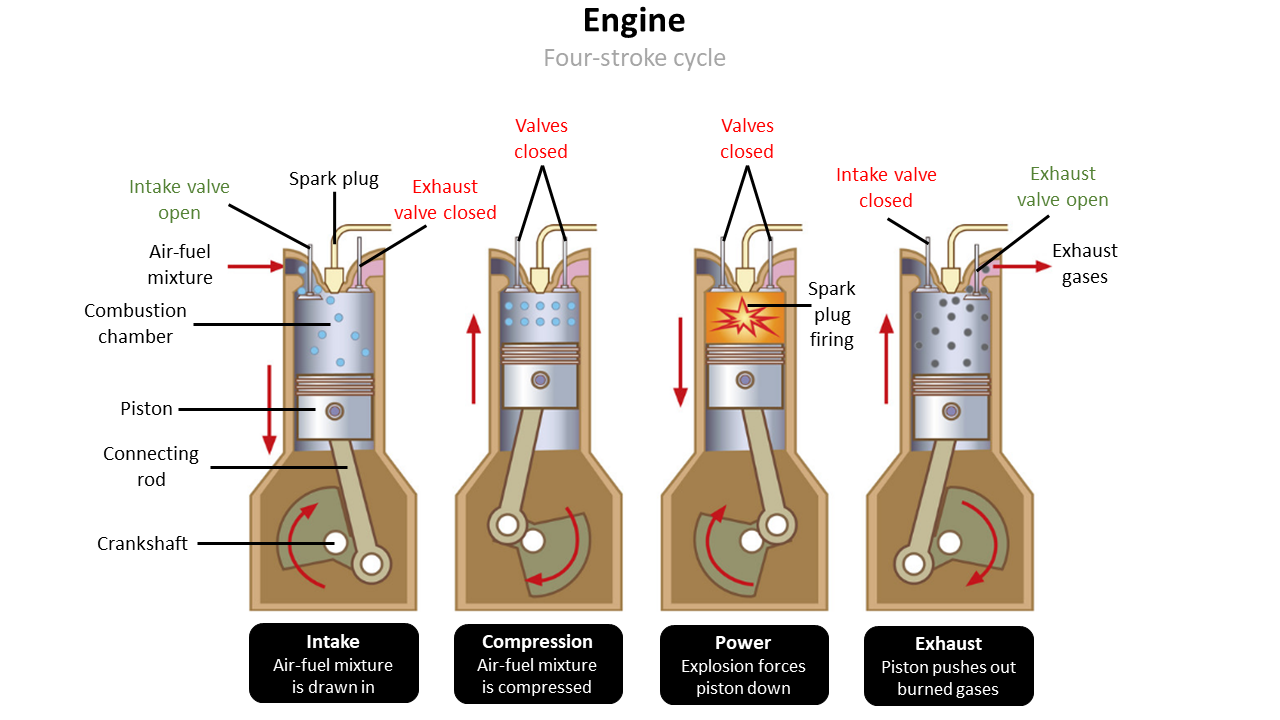
Note that this transformation of chemical energy into mechanical (kinetic) energy is not very efficient. Its efficiency is measured as the ratio between the created mechanical energy and the thermal energy released by combustion. Efficiency used to be very poor for car engines 50 years ago at around 15%, but has progressed a lot since, reaching around 35% today. The same efficiency indicator for industrial engines is 50%. Still, there is quite a bit of waste here as the rest of the thermal energy ends up heating the air around the engine… This is frustrating because this thermal energy has been obtained through combustion at the cost of releasing lots of carbon dioxide…
More about vehicles’ energy efficiency
Concerns about the climate are giving a new boost to the search for energy efficiency in transport. We have just seen that engines had progressed a lot but still wasted two-thirds of the energy obtained by burning petrol – and releasing carbon dioxide in the process. Worse: we saw earlier that kinetic energy delivered by the engine, materialised by the vehicle’s movement, is entirely wasted when we brake and stop – it all goes into heat via friction (by the way, this is why urban driving uses more petrol). A simple way to avoid this is not to use the brakes and never stop. I won’t bore you with technicalities, but this has a few side effects on security that we probably want to avoid. So here comes an interesting idea: when we slow the car down, could we re-transform its kinetic energy into some kind of potential energy we can reuse later? Yes, we could indeed. We can "connect" the car’s wheels to a strong dynamo. The dynamo’s resistance will slow the car down and generate electricity that will recharge a battery. Kinetic energy → electromagnetic energy → chemical energy.
Of course, to make full use of this chemical energy, your battery must feed more than the lights and electrical appliances of the car. It must provide at least part of the engine’s power, which means the car must have an electric engine.
Hybrid cars combine a power engine and an electric engine: they do not depend on chargers, which is very convenient. But the battery is too weak to power the car for a long time. It is only used for efficiency purposes: to absorb the kinetic energy of the car when braking, and deliver it back when accelerating. In addition, the power engine charges the battery at times when the car does not need much power. Inversely, the electric engine "helps" the power engine cope with peak energy requirements, e.g., during acceleration. Therefore, the power engine works more steadily than on a "normal" car, which improves its efficiency. This concept works very well in an urban context, much less so on a motorway where the car ends up relying on the power engine only, because there are no opportunities to "smartly" recharge the battery.
Fully electric cars also reuse the car’s kinetic energy, but it’s not enough to provide all the power they need. In theory it could, if all the kinetic energy of the car was retrieved and if electric engines were 100% efficient. In practice, we are far from this ideal case: electric engines are very efficient but dynamos less so, let alone batteries. And, for obvious security reasons, braking intensity needs to be adjusted with "traditional" brakes, which wastes energy into heat. Therefore, electric cars need some external power supply delivered by charging stations. We said that electric engines are very efficient. Indeed, they are – much, much more so than power engines: their efficiency is about 98%! And they don’t shed any carbon dioxide. The perfect option? Well, it all depends on the way the electricity they use has been produced. More on this later!
To come…
"Most of our energy ultimately comes from the Sun"… What are the other sources?
-
Geothermal sources: "central heating" – volcanos, geysers, hot springs
-
The Earth’s spin: how tides make days longer (I promise, they do!)
-
Rest mass energy: the famous E=mc2!
Electromagnetic energy: waves or photons?
Nuclear energy versus chemical energy: Goliath versus David
Kinetic energy at very high speeds: a bit of relativity
Some interesting series of energy transformations
A bit of philosophy: we said that science just proposes models, not universal truths. Is energy conservation a universal truth?