Prologue
Click here for downloadable PDF version.
Introduction
Let’s get one thing out of the way: I find the natural sciences fascinating. This paper is opening a series whose ambition is to share this fascination, and perhaps to spark some new interest in this topic. So don’t expect a serious analysis of science vs ethical dilemmas, or the importance of science vs other areas of knowledge – I am way too biased for that. Rather, expect a hopefully pleasant and understandable explanation of some key scientific concepts, through examples that you can easily reuse to impress whomever you need to impress in cocktail conversations.
This "prologue" will first give a hint of what science is about and how it shapes the world we live in. Then it will go through a few useful concepts that will come in handy when describing the world around us in scientific terms in the next papers of our series… Finally, a Reference Appendix will introduce a few useful notations and describe the various units of measurement we will encounter in this series. Some of these measures will be properly introduced in later papers, but it’s good to have them all in one place for future reference.
Science
So, about science… Here I may have a slightly more political objective: science and scientific reasoning are recurrently questioned by religions that hang on to absolute truths, or simply by people who want to believe or convince that "their" truth is stronger than facts. But science does not propose a truth against which to set another truth. It just builds models of reality – a more modest but more verifiable proposition. Let’s elaborate a bit.
Science seeks to explain how the world works – not why, just how. You observe what is going on and you try to find a model that describes it, allowing you to predict what will happen in similar situations. This may sound logical and basic to us, but a couple of centuries ago, science represented quite a revolution in a world where knowledge was dominated by religion, which had a completely opposite approach: state a universal truth and judge facts against this pre-defined, unchanging truth. No truth in science, only models that have to tally with facts or else be updated!
A famous example of the scientific approach is that applied by Newton, who allegedly observed an apple falling from a tree… an apple accelerating towards the ground. How do we model that? Well, we can model that by saying that some force is attracting the apple to the ground. Measure this acceleration for different apples. Then with a bit of maths, predict the movement of the apple (where it should be after falling 0.5, 1, 2 seconds, what happens if you throw it, etc.). Then test the model. Drop or throw various objects. Under certain conditions, you will see it works well. You can repeat your test, objects react as you predicted they would. Every time. As long as they are not too light and/or not too fast, because then the air slows them down (due to friction – we will come back to this in our next paper), and you need to factor this in your model. Then you can safely say: under certain conditions, the model works. You can predict the objects' behaviour and you can take advantage of this knowledge – for example to launch ballistic missiles… More on Newton in the next section!
Applying a model is (well, relatively) easy. Inferring it from observation is an altogether different challenge. Especially when you address areas that we cannot observe "naturally" around us – typically at very large distances and speeds, or on the contrary, for very small particles: in such cases, the behaviour of these objects does not correspond at all to the intuition we have built when observing "normal size" objects. So the guys who managed to model their behaviour are just f…ing geniuses.
No model works in all cases, so we keep identifying new conditions beyond which our models need refining. But a model applied under the right conditions works. Every time. You can verify it through experimentation; in fact, any number of independent scientific teams can verify it. So it’s not an absolute truth, it’s only a model that matches what we observe. But you can verify it.
And the beauty of it all is that being able to predict how objects will behave thanks to these models, you can build systems that do what you want, leveraging this anticipated behaviour. Lots of very good engineers work on this of course, finding super-smart applications of scientists' models: electricity, chemical industry, dams, bridges, buildings, processors, medical instruments, transportation, phones… every man-built object in our lives exists because scientists managed to find the right models. And I repeat: engineers are smart guys and do wonders. But the great scientists, those who are/were able to imagine the core models that describe the world… I am not even able to imagine the power of their brains. And they changed our lives more than any businessman or politician. OK, I have made my point, I think…
One word about the fundamental laws of physics (there will be a lot of physics in this series, because… well, if I’m honest, mainly because I like physics)… Some rules emerge as "landmarks" that remain valid across all the models built so far. The most famous one is that the energy of a system remains constant if the system does not interact with the rest of the world (we’ll see a lot more of this one in future papers of this series). These landmark rules become "fundamental laws" and new models make sure they respect them to ensure consistency with other models… and increase their chances of being relevant. A model where energy is not constant is very unlikely to resist scrutiny… Here you may say: "but you just said there is no absolute truth in science". A very interesting point actually, one that merits a discussion of its own. We will come back to this at the end of our series on energy.
Now a few words about maths… Maths is a bit special. It’s not a natural science. It doesn’t model something we observe, although mathematical intuition does borrow from the tangible reality around us – for example, we visualise number 4 as a collection of 4 "real" objects. But other than that, maths lives by itself.
In maths, we start from assumptions. Maths is basically about this: "Let’s assume that these core rules are true…", or "Let’s assume that these objects or these operations between objects have these particular properties… What can we infer from that?" And the game consists in inferring as many derived rules and properties as possible, from as few assumptions as possible (so that the application field is as broad as possible). Can be a bit pedantic at times, but in some cases the power of this approach is really surprising.
So you start from these minimal assumptions, this core set of objects, properties, and rules. Then you smartly apply your core rules to specific objects to derive secondary rules (theorems, properties that apply to certain objects, etc.). Then you apply these new rules to the right objects and you enrich your set of rules progressively deducted from one another through logical reasoning. Sometimes you guess that a new rule applies but the trick is to prove it, i.e., to show that it can be deducted from already proven rules and ultimately from the initial assumptions.
Until you have proved it, your new rule is only a conjecture. A bit like in physics: you can see it’s a good model, it seems to work for all the examples you can think of. But here a conjecture is not good enough. You need to prove it always applies (as long as the initial assumptions are valid). It’s a big difference when compared with other sciences, which are content with "it’s consistent with other models, it applies repeatedly to all the cases we have imagined, so I validate it until someone comes up with an edge case that doesn’t work". Unlike physics, maths demands proof. And proving some conjectures can be horrendously difficult – some resisted for over a century!
Maths is a great tool for other sciences because it allows you to say "if this is true, then this is true too" – the basis of reasoning. More concretely, maths provides all the calculation tools and abstract objects other sciences need for their models. Indeed, some physicians found they lacked mathematical tools (=adequate sets of objects, properties, and rules) and had to work on maths for a while to build those tools before returning to physics. This can sound a bit abstract but just look at physics' models: they often take the form of mathematical formulae. And believe me: in some cases, physics has led maths into new areas that are quite complicated…
Now, let’s get started with Newton’s physics. We’ll begin with a fundamental law of physics that defines the relationship between an object’s movement and the force you apply to it. This will lead us to understanding a bit more about gravity. On the way, we will gather a few concepts that will serve us well in our next papers…
Illustrating a model: force, mass, acceleration, and supermarkets
If you want to study physics, pick an empty trolley in a supermarket. When you push it around, you can do whatever you want effortlessly: move, turn, accelerate, slow down, turn, stop. You hardly need to "force" the trolley. You push or pull it slightly in the right direction, applying a small force, and it follows. Now load your trolley with bottles of milk. Why milk? Because it’s heavy and healthier than wine. OK, wine will do too. (By the way, what does "heavy" mean? More on this later.) What happens when the trolley is full? As long as you walk regularly along a straight aisle (whatever your speed), you see no real difference with the empty trolley. You hardly have to push it along, it follows its momentum. But try to accelerate, and it becomes a different story: you need to push much harder. The heavier the trolley, the harder you need to push to get a reaction. And the harder you push, the more it reacts and accelerates. Why not try a simple model here: the applied force is proportional to the mass of the trolley and to its acceleration. And if you use the right unit, you can even try: force = mass x acceleration. Bingo, it works. It works so damn well that it has become the core principle of Newton’s mechanics, a fundamental law of physics.
Note that it’s also difficult to slow the heavy trolley down, or to change its direction. In fact, it’s difficult to change its speed, be it in amplitude or direction. This tallies perfectly with the definition of acceleration in physics: it doesn’t just mean "go faster", it means "speed variation per second". Speed, also called velocity (v) in physics, is modelled by an amplitude (how fast you go) and a direction (in which direction you are going). So is acceleration. If acceleration is in the same direction as velocity, we get the common meaning of acceleration (go faster); if acceleration is in the opposite direction to velocity, then the object is slowing down. If acceleration is perpendicular to velocity, velocity changes direction but keeps the same amplitude – this, also, is easy to figure out if you imagine how you change the direction of a trolley. If acceleration is in yet another direction (neither parallel nor perpendicular to velocity), then velocity changes both in amplitude and direction. The applied force also has a direction, of course. And the magical formula force = mass x acceleration also applies to the direction, in the sense that acceleration has the same direction as the applied force.
A word about units here:
-
Mass is measured in kg.
-
In everyday life, speed is measured in km/h. However, in physics, velocity is rather measured in metres per second (m/s; do the maths: 1m/s = 3.6km/h).
-
Acceleration being a velocity variation per second, it is logically measured in "metres per second per second": (m/s)/s, usually noted m/s2.
-
Force’s unit of measurement is called… the "Newton" of course(!), signified by N. It is calibrated to ensure that force(N) = mass(kg) x acceleration(m/s2) – and not, for example, force = 1.38866328763 x mass x acceleration…
Another very important point if you want to sound more credible in cocktail conversations… In physics jargon, force is symbolised by the letter f, mass by m, acceleration by the Greek letter \$\gamma\$ (gamma). Therefore the casual geek way of evoking this fundamental law is: f = m\$\gamma\$. Just so you know. You will often find a small arrow above f and \$\gamma\$, to show that f and \$\gamma\$ have the same direction: \$\vec{f}\$ = m\$\vec{γ}\$. We will omit it in the rest of this prologue, but it’s there!
You may wonder why I am using the word "mass" instead of "weight". And NO, it’s not because it sounds better in cocktail conversations (although it does). The weight of the trolley refers to how heavy it is, i.e., how hard it is to lift it from the ground. Or if you prefer another image, how hard it presses against the ground. But soon, with guys like Elon Musk, you will have a chance to go to outer space for a holiday. There your trolley will be floating, perfectly weightless. Weightless, but not without mass. Try pushing it to accelerate it or change its direction, you will have to apply exactly the same force as in your supermarket, and f = m\$\gamma\$ will still work perfectly (believe me, it’s been verified via experiments many times). So the mass of your trolley is still there, not its weight. Mass is a property of the trolley (measured in kg), while weight is the force that applies to the trolley when attracted by the Earth (measured in N, although we use kg in common language because we see mass and weight as equivalent when on the ground). Big difference, right? Which leads us to apples…
Apples and gravity
Newton was having a nap under an apple tree. An apple fell and hit his face, waking him up rather abruptly. (This is not science, it has not been verified!). Rather than cursing, Newton wondered: "this apple accelerated pretty fast to hit me with that speed… and f = m\$\gamma\$, so… what force is dragging it to the ground?" Wherever we are on the planet, this force always points at the ground. A reasonable assumption is that the Earth attracts the apple. Indeed, this is the real meaning of weight: the attraction force the Earth exerts on any massive object. The cocktail name of this attraction is gravity.
Then we observe that apples and other objects, with certain limits related to air resistance, all accelerate the same way when dropped – regardless of their mass. This common acceleration, constant throughout the fall, is called "gravitational acceleration", signified by the symbol g. But f = m\$\gamma\$… so if you take a bigger apple, it takes a bigger force to obtain the same acceleration, right? The Earth’s attraction force must be proportional to the apple’s mass. And of course it is, basic intuition tells us so. weight = m\$\gamma\$ = mg, whatever the value of m is. g being constant across the surface of the Earth and varying very slowly with altitude, no wonder we happily confuse weight and mass!
Now it can all become a lot more interesting… when you push your trolley, you will feel it resists… it pushes your hands back, so you need to lean forward to keep your balance. If you study the consequences of f = m\$\gamma\$ in detail, you will find that the reaction of the trolley onto your hands is a force exactly opposite to the force you apply to the trolley. Similarly, you will find that if the Earth attracts the apple, the apple also attracts the Earth by the same force… Of course, given the huge mass of the Earth, the Earth does not accelerate much towards the apple! Now look at the symmetry here. Would it make sense to assume that the force the apple and the Earth apply to each other (call it weight) is proportional to the mass of the apple AND to the mass of the Earth? Weight = mass apple x mass Earth x "a thingie". Then f = m\$\gamma\$ tells us two things:
-
applied to the apple: weight = mass apple x acceler.apple implies that the acceleration of the apple (g) equals mass Earth x "a thingie"
-
applied to the Earth: weight = mass Earth x acceler.Earth implies that the acceleration of the Earth is mass apple x "a thingie" = g x mass apple / mass Earth (we see very well that it’s negligible compared to the acceleration of the apple! In practical terms, the Earth, of course, doesn’t move towards the apple).
Next question, even more interesting: what is this "thingie"? When in outer space, the apple floats. It doesn’t accelerate towards the Earth. So where is g gone? A reasonable assumption is to say that gravitational force decreases with distance from the Earth. A bit of experience will prompt you to assume that it decreases proportionally to the square of the distance from the centre of the Earth. So: weight = mass apple x mass Earth x "something" / square distance. Or if you prefer, g = mass Earth x "something" / square distance, g now depending on the distance from the centre of the Earth… And if we are right, "something" remains constant. And lo and behold, it does. We call it G, universal gravitational constant. Now we can forget the Earth and the apple. Because if we are right, we can be a lot more general: 2 objects of respective masses m1 and m2, their respective centres at distance r, attract each other with a force equal to m1 x m2 x G / r2, G being a universal constant. At our usual scale, G is very small so you need at least m1 or m2 to be very large for the force to be detectable (or r has to be very-very small, but it can’t, as it has to be larger than the sizes of the objects!). So, does it work? You bet it does!
Of course, there are a few limitations, as in any model: when distances and speeds get very large, then something starts going wrong. Relativity will be needed in that case. Much, much more complicated to explain (we’ll try in a future paper!), let alone to figure out… And when r becomes very small (in the case of atoms, for example), the model becomes dodgy as well – and interactions other than gravity step in. Quantum mechanics will sort this out at the cost of horrendous mathematical complications… But at "our normal scale", Newton’s model just works perfectly – so much so that mechanics, the area of physics that studies the motion of macroscopic objects, is often referred to as "Newton’s mechanics" as opposed to "relativist mechanics" (for very high speeds) and "quantum mechanics" (for very small scales).
More fun: look at a satellite. It goes very fast (Newton’s model still works very well at these speeds though), and its weight draws it towards the Earth. So it turns towards the Earth, but it’s so fast that it falls "beyond the Earth" and its weight remains perpendicular to its velocity – so the amplitude of its velocity doesn’t change. It keeps rotating round the Earth. Same for the moon. Same for the Earth around the Sun. From there, it’s just maths to figure out distances between planets, their mass, etc. And also to predict tides, to design ballistic missiles, and so many other fun things. Just because we have a good model. Isn’t that amazing?
In our next paper, we’ll start a series about another fundamental concept we have not touched upon yet: energy! Very original, powerful, and simple to use, this concept (and the related "landmark" law) has countless interesting (and sometimes unexpected) applications around us…
Questions you may ask… if you want to go further
Question 1: In the supermarket, the trolley stands still or moves horizontally. It obviously has no vertical acceleration, so the vertical force on the trolley should be zero. But what about its weight ─ it surely is still there, dragging it down?
Yes, of course. But in f = m\$\gamma\$, f is the sum of all applied forces, in all directions. Vertically, the total force applying to the trolley has to be zero. And it is, because the ground reacts to the trolley’s weight by applying the exact same force to the trolley ─ but upwards. Actually this force from the ground applies to us too, reacting to our own weight. We are hardly aware of it because our legs and feet are so used to it… but take your shoes off and stand on gravel…
Question 2: OK, but if I pull my trolley up, nothing happens (unless I pull really hard)?
Indeed. Your upward force remains smaller than the weight of the trolley. Therefore your effort + the weight still amount to a downward force, compensated by the ground’s reaction. All that happens is that the ground’s reaction is now smaller ─ you "lighten" the trolley.
Question 3: OK, but here we are talking about conveniently aligned forces ─ both vertical. How do you add up forces that point to different directions?
Well, that’s a good question. An example of how maths helps us with their habit of looking for rules that apply as broadly as possible. You can add up objects that are a bit more generic than numbers ─ called vectors. Vectors can conveniently represent force, or velocity, or acceleration. Anything with a value and a direction. Now push your trolley in any direction, also pushing it slightly upwards. You can say the force you are applying is part vertical, part horizontal. And the horizontal bit is part along the aisle, part perpendicular to the aisle. Actually each of these three components (parallel to aisle, perpendicular to aisle, vertical) can be quantified. Now your force f is represented by 3 numbers. Call that a 3-dimension vector at cocktail parties (a vector is any group of n numbers). The 2 horizontal directions and the vertical direction are traditionally referred to as x, y, z, therefore the 3 components of f are typically noted (fx, fy, fz). And remember the arrow on top of f to mention it has a direction ─ it actually says that f is modelled as a vector \$\vec{f}\$ = (fx, fy, fz).
We can visualise this with an arrow representing \$\vec{f}\$ in the supermarket:
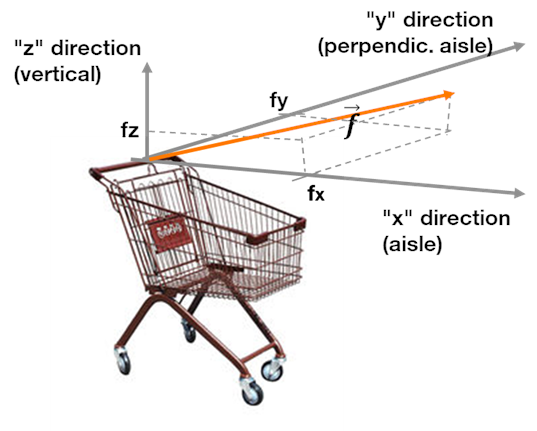
Do this for every force applying to the trolley:
-
The force you apply is: \$\vec{f}\$ = (fx, fy, fz). As per your previous question, fz is positive (upward) but we assume it’s too small to lift the trolley.
-
The weight of the trolley, call it \$\vec{w}\$, is vertical: it only has a "z" component, negative because it points downward, equal to the full weight w of the trolley: \$\vec{w}\$ = (0,0,-w)
-
The ground’s reaction, call it , is also vertical, pointing upward (positive): \$\vec{r}\$ = (0,0,r) (to be accurate: if the load of the trolley is balanced, r/4 applies to each wheel!)
Now we can answer your question and calculate the total force applying to the trolley, simply by adding up the components of all identified forces along each direction. The three sums are the three components of the total force: \$\vec{f}\$total = (fx, fy, fz + r-w).
We can even go a bit further: if we know the weight of the trolley and the force you are applying, we can calculate the acceleration of the trolley and the reaction of the ground (r):
-
Let’s play the same "vector game" with acceleration γ – or, should I write: \$\vec{γ}\$ = (\$\gamma\$x, \$\gamma\$y, 0). The third component is zero because acceleration is horizontal. Multiplying \$\vec{γ}\$ by m comes down to multiplying its three components by m: m\$\vec{γ}\$ = (m\$\gamma\$x, m\$\gamma\$y, 0).
-
Then our magical formula says \$\vec{f}\$total = m\$\vec{γ}\$ from which we infer:
-
fx = m\$\gamma\$x, hence \$\gamma\$x = fx/m
-
fy = m\$\gamma\$y, hence \$\gamma\$y = fy/m
-
fz+r-w = 0, hence r = w-fz
The fact that r is smaller than w materialises the fact that you "lighten" the trolley by pushing slightly upward.
-
More generally, in mechanics, calculating the trajectory of an object involves the following items:
-
The position of our object, also modelled as a vector, say \$\vec{pos}\$. Its components are often noted a bit specifically: \$\vec{pos}\$ = (x, y, z) instead of (posx, posy, posz). This position changes with time t, therefore we note it: \$\vec{pos}\$(t) = (x(t), y(t), z(t))
-
The velocity of our object. It also changes with time, therefore we note it \$\vec{v}\$(t) = (vx(t), vy(t), vz(t)). We can say that \$\vec{v}\$(t) represents the variation of \$\vec{pos}\$(t).
-
The acceleration of our object, \$\vec{γ}\$(t). Similarly, \$\vec{γ}\$(t) represents the variation of \$\vec{v}\$(t).
-
And of course the sum of the forces that apply to your object, \$\vec{f}\$total(t).
In many instances, \$\vec{f}\$total(t) can be expressed as a function of \$\vec{pos}\$(t) [1] and/or \$\vec{v}\$(t) [2].
As a consequence, the relation \$\vec{f}\$total(t) = m\$\vec{γ}\$(t) can be transformed into an equation that binds \$\vec{pos}\$(t), \$\vec{v}\$(t), and \$\vec{γ}\$(t). In other words, a relation between \$\vec{pos}\$(t), its variation and the variation of its variation! Maths will rescue us here… Such equations are called differential equations, and have been studied extensively. They allow us to calculate \$\vec{pos}\$(t) as a function of time only, i.e. to predict the object’s trajectory. To be honest, most differential equations can’t be solved into clean formulae. Instead, \$\vec{pos}\$(t) has to be calculated step by step by a computer, following small time increments. But in some very useful cases, we can find a nice formula describing \$\vec{pos}\$(t), a famous example being the movement of satellites around planets, or planets around stars.
Reference Appendix: Notations and Measures
Physical quantities like distance, velocity, mass, force, energy, etc. are expressed as an amount of measurement units – e.g. a distance of 10 meters. The scale of a physical quantity can vary considerably depending on the context, requiring different units of measurement for obvious practical reasons: measuring distances between particles and distances between stars in the same unit would involve pretty unwieldy numbers… Another way to navigate more easily between very different orders of magnitude consists in using powers of 10 to express large values: 103 instead of 1000, 106 instead of 1000000, etc. (as a reminder, the superscript indicates the number of zeros). When you reach values like 1030 (it happens!), you start liking those mathematical notations…
The same is true for very small values: we’ll use negative powers of 10. 10-1 = 0.1, 10-3 = 0.001, 10-6 = 0.000001. Note that for a given number n, 10-n equals 1/10n. More generally, for two given numbers n and p (positive or negative), 10n x 10p = 10n+p. Hence the convention 100 = 1.
Important for cocktail conversations: 10n is pronounced "10 to the nth power", or better "10 to the nth" (the latter sounds more casual, implying that you handle powers of 10 on a daily basis). Similarly, 10-n is pronounced "10 to the minus n".
Also, physical models involve relationships between different physical quantities, hence relationships between the corresponding units of measurement. We have already seen some simple examples: velocity, corresponding to a distance divided by a time duration (meters divided by seconds), is measured in meters per second and noted m/s. Similarly, acceleration is velocity variation (m/s) divided by time duration (s); it is therefore measured in (m/s)/s, or m/(s x s) – more conveniently written as m/s2. Force, being mass multiplied by acceleration, could be expressed in kg x m/s2 (or the alternative notation kg.m/s2). However, using N (Newtons) is obviously more compact, and more meaningful.
The table below summarises the main units and sub-units of measurement we will come across in this series, as well as the relationships between them. Many of them will be introduced later – this table is just meant to serve as a reference if you are interested, so don’t read it now, but feel free to keep coming back here as you are progressing with the series!
Distance
| Unit of measurement | Abbreviation | Definition |
|---|---|---|
meter |
m |
Reference distance in the International System of Units (SI) |
Smaller units |
||
centimetre |
cm |
0.01m (or 10-2m) |
millimetre |
mm |
10-3m |
micrometre (micron) |
µm |
10-6m (or 10-3mm) – order of magnitude of visible light’s wavelengths |
nanometre |
nm |
10-9m (or 10-3 µm) |
Angström |
Å |
10-10m (or 0.1nm) – typical size of an atom |
picometre |
pm |
10-12m (or 10-3 nm) |
femtometre |
fm |
10-15m (or 10-3 pm) – size of a nucleon… 100000fm in 1Å, |
Larger units |
||
kilometre |
km |
1000m (=103m) |
astronomical unit |
au |
150 x 109m (150 million km, Earth-Sun distance) |
light-year |
ly |
9.46 x 10¹⁵m (9460 billion km, distance covered by light in one year) |
Time
| Unit of measurement | Abbreviation | Definition |
|---|---|---|
second |
s or sec |
Reference time duration in SI |
Larger units – same as common usage |
||
minute |
min |
60s |
hour |
h |
3600s = 60min |
day |
d |
86400s = 24h (Earth’s spin period) |
year |
y or yr |
31.5576 x 10⁶s = 365.25 days (Earth’s rotation period around the Sun) |
Speed and acceleration
| Unit of measurement | Abbreviation | Definition |
|---|---|---|
metre per second |
m/s |
Standard unit for measuring speed in physics |
kilometre per hour |
km/h |
Common driving speed measurement unit |
mile per hour |
mph |
Unauthorised unit… |
metre per second squared |
m/s2 or |
Standard unit for measuring acceleration in physics |
Mass
| Unit of measurement | Abbreviation | Definition |
|---|---|---|
kilogramme |
kg |
Reference mass in SI |
Smaller units |
||
gramme |
g |
10-3kg (We all know that 1kg=1000g; the naming suggests that gramme is the reference and that kilogramme is defined as 1000g… but in fact the reference is the kg.) |
electron-volt |
eV/c2 |
1.78 x 10-36kg = mass corresponding to a rest mass energy of 1eV (See energy units below.) |
Larger units |
||
ton |
t |
103 kg |
kiloton |
kt |
103 tons |
megaton |
Mt |
106 tons, can go on with giga- (109), tera-(1012), peta-(1015) |
Electricity
| Unit of measurement | Abbreviation | Definition |
|---|---|---|
coulomb |
C |
Conventional unit to measure electric charge at "man scale". Definition is given by the value of the elementary charge e (that of an electron or a proton): e = 1.6 x 10⁻¹⁹ C |
ampere |
A |
1C/s, unit for measuring electric current intensity |
volt |
V |
1J/C, voltage giving a potential energy of 1J to a charge of 1C |
Energy and power
| Unit of measurement | Abbreviation | Definition |
|---|---|---|
Joule |
J |
1J = 1kgxm2/s2 = 1VxA, unit for measuring "man-scale" energy |
Smaller energy units (mJ, µJ, etc. are not commonly used) |
||
electron-volt |
eV |
1.6 x 10⁻¹⁹J = potential energy of an electron when "pumped" by 1V |
kilo- |
keV |
103eV (1.6 x 10⁻¹⁶J) |
Power and alternative energy units |
||
Watt |
W |
1J/s = power delivering an energy of 1 Joule per second |
Watt-hour |
Wh |
3600J, energy delivered by a 1W-source in one hour |